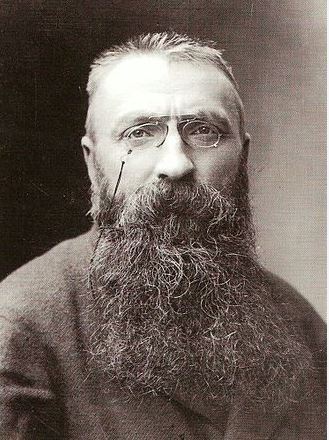
Auguste Rodin, one of the most influential sculptors in history, revolutionized the art of sculpture in the late 19th and early 20th centuries. His ability to infuse emotion, movement, and raw human experience into his works set him apart from his contemporaries and laid the foundation for modern sculpture. Often compared to Michelangelo for his mastery of form, Rodin’s sculptures remain some of the most celebrated and studied artworks in the world.
Early Life and Artistic Beginnings
François-Auguste-René Rodin was born on November 12, 1840, in Paris, France, into a modest family. From an early age, he displayed a keen interest in art, particularly drawing. Despite his evident talent, Rodin’s early years were fraught with challenges. He applied three times to the prestigious École des Beaux-Arts but was rejected each time. Undeterred, he continued his studies at the Petite École, a less renowned art school, where he honed his skills in drawing and sculpture.
Rodin’s artistic journey was not straightforward. For many years, he worked as a decorative sculptor, assisting in architectural embellishments and ornamental designs. During this period, he developed a deep appreciation for texture, depth, and the expressive potential of sculptural forms. His career took a turning point in the 1870s when he traveled to Italy and was profoundly inspired by the works of Michelangelo. This encounter ignited in him a desire to push the boundaries of traditional sculpture.

The Breakthrough: The Age of Bronze
Rodin’s first major success came in 1877 with The Age of Bronze, a life-sized sculpture of a young soldier. Unlike the rigid, idealized sculptures of his time, Rodin’s piece was intensely realistic, capturing the nuances of human anatomy and movement. However, the realism was so striking that critics accused Rodin of casting the sculpture from a live model rather than sculpting it by hand. Although this controversy initially brought him scrutiny, it ultimately boosted his reputation, cementing his place as a revolutionary artist.
The Gates of Hell: A Magnum Opus
In 1880, Rodin received a commission from the French government to create a monumental doorway for a new museum. Inspired by Dante’s Inferno, Rodin embarked on what would become his most ambitious and complex work, The Gates of Hell. This massive project, featuring over 180 figures in various states of torment and passion, occupied Rodin for decades, though it was never fully completed in his lifetime.
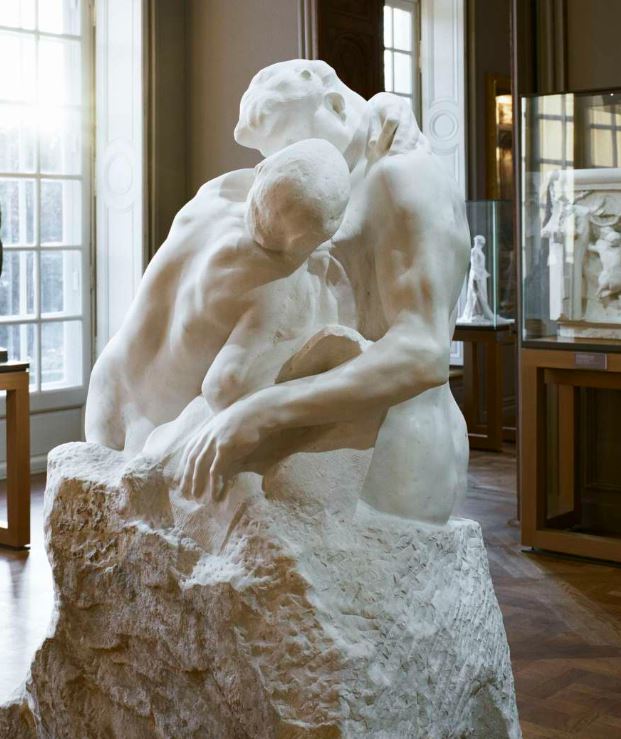
Many of Rodin’s most famous sculptures emerged from The Gates of Hell, including The Thinker, The Kiss, and The Three Shades. The Thinker, originally conceived as a representation of Dante contemplating his journey through hell, evolved into a universal symbol of philosophy and human introspection. The Kiss, depicting the tragic lovers Paolo and Francesca from The Divine Comedy, became one of Rodin’s most romantic and celebrated pieces, embodying both passion and tragedy.

Rodin’s Unique Style and Techniques
Rodin’s approach to sculpture was groundbreaking. Unlike traditional academic sculptors who sought to create smooth, polished, and idealized forms, Rodin embraced rough textures, asymmetry, and incomplete forms to emphasize movement and raw emotion. His technique of non-finito (leaving parts of his sculptures seemingly unfinished) was a departure from classical ideals and added a dynamic, almost living quality to his work.
Rodin also revolutionized the use of clay models, creating multiple variations of his sculptures before casting them in bronze or carving them in marble. This allowed him to experiment with composition and refine the expressive potential of his figures. His innovative methods had a profound influence on future sculptors, paving the way for modern and abstract sculpture.

Fame and Controversies
By the 1890s, Rodin had become one of the most celebrated artists in France and beyond. His works were exhibited internationally, and he gained patronage from collectors, aristocrats, and even royalty. Despite his success, Rodin frequently faced criticism, particularly for his unconventional methods and provocative themes.
One of his most debated works was Monument to Balzac, commissioned in 1891 by the Société des Gens de Lettres. Rather than depicting the French writer Honoré de Balzac in a traditional, dignified pose, Rodin presented a larger-than-life figure draped in a heavy robe, exuding an almost supernatural presence. The sculpture was initially met with outrage and rejection, but today it is regarded as a masterpiece of modern sculpture, demonstrating Rodin’s ability to capture not just physical likeness but the very essence of his subjects.

Personal Life and Relationships
Rodin’s personal life was as complex as his art. He had a long and tumultuous relationship with Camille Claudel, a gifted sculptor who was also his student, collaborator, and muse. Their passionate affair influenced both their works, but it ended in tragedy, with Claudel suffering from mental illness and spending her later years in an asylum. Rodin’s relationship with his lifelong companion, Rose Beuret, was more stable, and they married just a few months before her death in 1917.
The Rodin Museum and His Lasting Legacy
In his later years, Rodin achieved widespread recognition, and his influence extended beyond sculpture to modernist movements like Expressionism and Surrealism. He donated much of his work and personal collection to the French government, leading to the establishment of the Musée Rodin in Paris in 1919, two years after his death. Today, the museum remains one of the most visited art institutions in France, housing many of Rodin’s most iconic pieces.
Rodin’s legacy is immeasurable. His innovative approach to form, texture, and movement broke away from classical constraints and opened new artistic possibilities. He inspired countless artists, from Henry Moore to Alberto Giacometti, and his influence can still be seen in contemporary sculpture today.
Conclusion
Auguste Rodin was not just a sculptor; he was a visionary who redefined what sculpture could be. His ability to capture human emotion, movement, and psychological depth set him apart from his peers and established him as a true pioneer of modern art. His works continue to resonate with audiences worldwide, proving that art, at its core, is not just about representation but about evoking the deepest aspects of the human experience.
Discover more from French Glimpses
Subscribe to get the latest posts sent to your email.
